








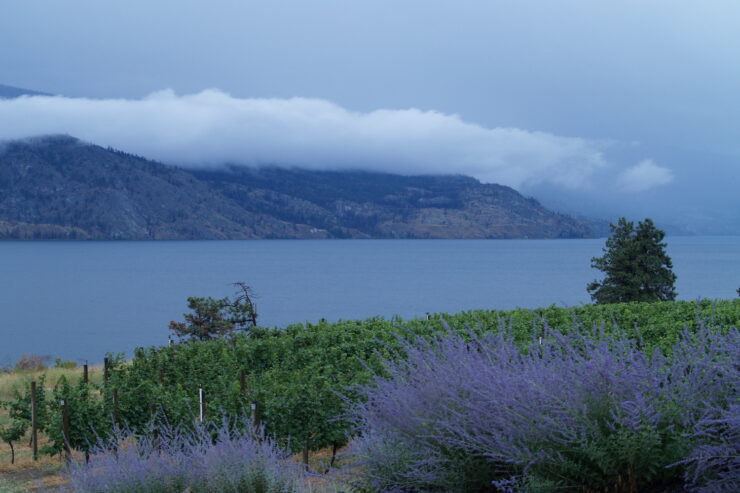
Canada is big. Really big. And has hundreds of thousands of lakes. Over 100,000 in Manitoba alone, according to the Canadian Broadcast Corporation. At least a few of these lakes have their own monsters.
The most famous one, Canada’s Nessie, is the Ogopogo of Lake Okanagan in British Columbia. I’ll talk about her in another article. Here, let’s look at some of the less celebrated monsters.
We have no idea how many actual lake monsters there are. So much of Canada is wilderness, and the population in much of the rest is thin. Even if people are seeing strange things in remote lakes, we may not be hearing about them.
It’s not just colonizers imposing their own myths and legends on the lands they’ve taken, bringing tales of the water horse and the kelpie to the so-called New World. First Nations peoples told stories of strange things in the water. Maybe they were (or are) animals unknown to science. Maybe they were (or are) spirits. Or maybe they’re real.
Canadian lake monsters in general fall into a couple of categories. One is a long, snakelike, undulating creature. The Ogopogo is one of these. So is Cressie, in Crescent Lake in Newfoundland, and the Manipogo of Lake Manitoba. These may be large eels.
The other kind of lake monster is a shorter, stockier creature with a heavier body and sometimes flippers. Lake Superior’s Mishipeshu is unusually aggressive and has been known to capsize boats—including, it’s said, the Edmund Fitzgerald. Mishi is scaled and vaguely saurian, and appears in a precolumbian petroglyph with the head of a lynx and the body of a snake. She might be a prehistoric survivor, a living dinosaur. Or she might be an enormous, prehistoric-looking fish.
The Turtle Lake Monster is smaller than Mishi but fairly similar in type. It’s eight to ten feet long, dark in color, and possibly scaled, though it might be smooth-skinned, with a head like a horse or a dog. It could be a seal or a large otter, though an interesting and very Canadian suggestion is that it’s a moose. That would explain the color, the ambiguous texture, the hump, and the horselike head.
Moose are strong swimmers and will take to the water to get from here to there. If you’re looking out over the lake and see the head and the hump, you might see a lake monster instead of a large herbivorous mammal. That may explain the noises the monster is said to make, as well: Moose can make grunting sounds when they swim.
Another possibility is a sturgeon. They’re mostly bottom feeders, but they can and do rise up to the surface. They breach like whales, fly straight up into the air. They can easily swamp a boat.
Both moose and sturgeon are huge. Even if they’re not aggressive, if you’re out on the water and get in their way, they can be dangerous. If you see them from a distance, especially in poor light, they may look even bigger, and take on a mythic quality. They’re real and literal monsters.

Moose can also, when they choose, be surprisingly quiet for something that large. I once complemented an American camping in Algonquin Park with his remarkable calmness, given he had a moose calf and its mother grazing on the edge of his camp. Turned out he had not heard them arrive, didn’t hear them eating, and had no idea they were there until I pointed them out. As far as I know, he was not subsequently trampled to death.
Moose will sometimes forage in the ocean, where the unlucky ones get et by orca.
Canada shares Lake Erie with the US, but you forgot about Bessie.
It is a crying shame that ‘Canada’s big. Really big.’ didn’t link out to The Arrogant Worms song. Or at least footnote it.
Never heard of it. Do please provide the link.
https://www.youtube.com/watch?v=XhiDILWFXBE
Enjoy :)
They also wrote “Carrot Juice is Murder”, which is a blast.
Moose have the unfortunate characteristic that they are tall enough that when struck by cars, they can end up sliding up the hood and into the passenger compartment. This is hard on both moose and the car’s occupants.
There was an episode of Murdoch Mysteries (Canada’s grittily realistic police procedural about such believable things as manned orbital rockets circa 1910) in which George mentioned off-handedly that one of his many Newfoundlander aunts had moved to Ontario, disliked all the moose, and moved back to Newfoundland. That struck me as odd, because Newfoundland has moose. When I double-checked, I discovered that moose were only recently introduced to Newfoundland. When the episode was set, Newfoundland was moose-free. And someone on the show not only knew that but wrote it into an episode.
The small town that my father grew up in (Cobden, Ontario) has its own lake monster: Mussie (in the Muskrat Lake). =g=
And for a moose masquerading as a lake monster, there is a story in the Mirabile novel/story collection by Janet Kagan. The whole book is well worth reading.